Traditional Indian Carpets: Types, History & Where to Buy Online
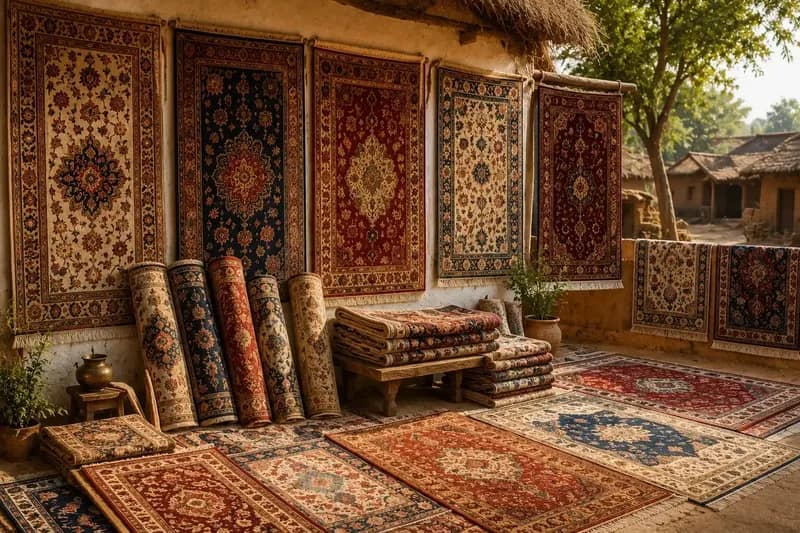
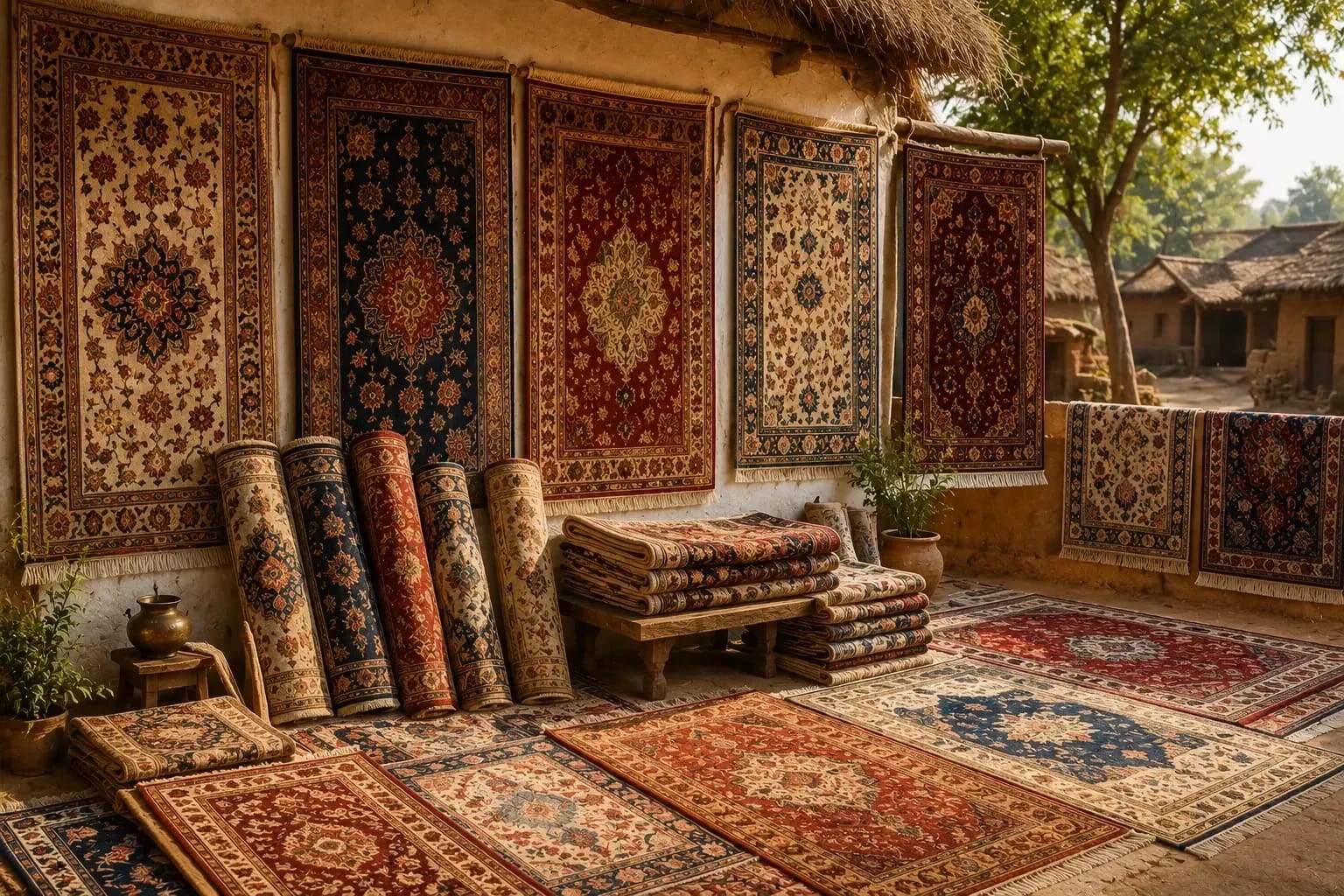
Traditional Indian carpets carry 500 years of history in every knot and tuft. India is one of the world's great carpet-producing civilisations, and understanding the diversity of traditional carpet types — from Kashmiri silk hand-knotted masterpieces to Bhadohi wool hand-tufted pieces crafted by third-generation artisans — helps you make a purchase with genuine meaning and lasting value. This guide covers the history, styles, materials, motifs, and price ranges of traditional Indian carpets, and explains how to find authentic pieces online.
At Rug Store, our traditional carpet range is sourced directly from Bhadohi, Uttar Pradesh, where artisan families have been weaving carpets since the 16th century. When you buy a traditional carpet from us, you buy a living piece of Indian cultural heritage.
The History of Indian Carpet Weaving
Mughal Patronage and the Persian Influence
The formal tradition of fine carpet weaving in India was established under Mughal Emperor Akbar in the 16th century. Akbar brought Persian master weavers to his royal workshops in Agra, Lahore, and Fatehpur Sikri, and charged them with training Indian artisans in the Persian knotting tradition — the same tradition that produced the legendary carpets of Isfahan and Tabriz.
The resulting Indo-Persian synthesis produced a distinctive Indian carpet vocabulary: Persian floral medallion layouts adapted with indigenous motifs — Indian flowers, Mughal architectural forms, and the curvilinear arabesque translated through an Indian sensibility. The best Mughal-era carpets are now in museum collections worldwide; but the weaving tradition they established has continued unbroken to the present day.
Bhadohi: India's Carpet Capital Since the 16th Century
The Bhadohi-Mirzapur belt in Uttar Pradesh became established as a carpet-weaving centre during the same Mughal period, as royal workshop traditions spread from the court cities to the surrounding regions. By the 18th century, Bhadohi had developed its own distinct carpet-producing identity, and by the late 19th century the district was exporting to European markets.
Today, Bhadohi produces approximately 80% of India's hand-knotted carpet exports and is the dominant production centre for hand-tufted carpets in the domestic market. The district employs over 200,000 artisans across thousands of workshops — from single-family looms to large export facilities. At Rug Store, we work directly with this artisan network to bring Bhadohi craftsmanship to Indian homeowners.
Types of Traditional Indian Carpets
Hand Knotted Wool Carpets (Bhadohi and Agra)
Hand knotted carpets are the pinnacle of Indian carpet craftsmanship. Each carpet is made on a vertical loom, with individual pile knots tied by hand onto the warp threads — a process measured in knots per square inch (KPSI). Premium Bhadohi hand knotted carpets achieve 100–200 KPSI, while Agra-style variants typically run at 60–100 KPSI. Higher KPSI means more intricate design capability and longer lifespan.
A 9x12 ft hand knotted wool carpet with complex floral design contains upward of 3 million individual knots, representing 6–12 months of skilled artisan labour. Prices reflect the months of skilled artisan labour involved — simpler Agra-style pieces represent the entry point, while densely knotted fine wool or wool-silk blend carpets in elaborate Mughal designs are investment-grade pieces. See current pricing on our product pages.
Hand Knotted Kashmiri Silk Carpets
Kashmiri silk carpets are the most refined and valuable traditional Indian carpets, produced in Srinagar and surrounding valley towns. Woven with pure mulberry silk on silk warps at 200–600 KPSI, these are tapestry-quality pieces as much as functional floor coverings. The silk lustre creates an almost three-dimensional visual depth as light strikes the pile from different angles.
Kashmiri silk carpets are primarily collecting and investment pieces, commanding premium prices that rise with size and knot density. They are best hung as wall art or used in very low-traffic formal rooms.
Hand Tufted Traditional Carpets (Bhadohi)
Hand tufted traditional carpets from Bhadohi bring the vocabulary of classical Indian carpet design — floral medallions, arabesque borders, Herati and paisley motifs — within reach of mainstream Indian homeowners. These are not machine imitations of traditional patterns; they are artisan-made pieces in which skilled tufters interpret traditional designs through the hand-tufting method, producing carpets of genuine beauty and character at accessible prices.
Our full traditional collection is available at rugstore.in/online-carpet-store/rugs-carpets/traditional-carpet/ — browse for current pricing in wool and wool-viscose blend across all standard room sizes.
Dhurrie Flat-Weave Carpets
Dhurries are flatwoven cotton or wool carpets with a long tradition in Indian homes, particularly in Rajasthan, Gujarat, and Punjab. Unlike pile carpets, dhurries have no raised surface — the design is created entirely through woven colour blocks, stripes, and geometric patterns in the flat weave. They are reversible, lightweight, and easy to clean — historically the everyday floor covering of Indian households before pile carpet production scaled up.
Traditional dhurrie patterns include bold geometric checks, stripes, and simplified floral motifs in strong colours. Modern dhurries in muted natural tones have become fashionable in contemporary Indian homes as a counterpoint to pile carpet formality.
Traditional Carpet Motifs Explained
Understanding the traditional motif vocabulary helps you choose a design with meaning and identify authentic craft work.
- Floral Medallion: Central circular or oval design surrounded by symmetrical floral scrollwork — the defining Mughal carpet motif; associated with abundance and harmony
- Arabesque / Scrolling Vine: Continuous spiralling floral vine filling the field — adapted from Persian design; represents the eternal cycle of growth
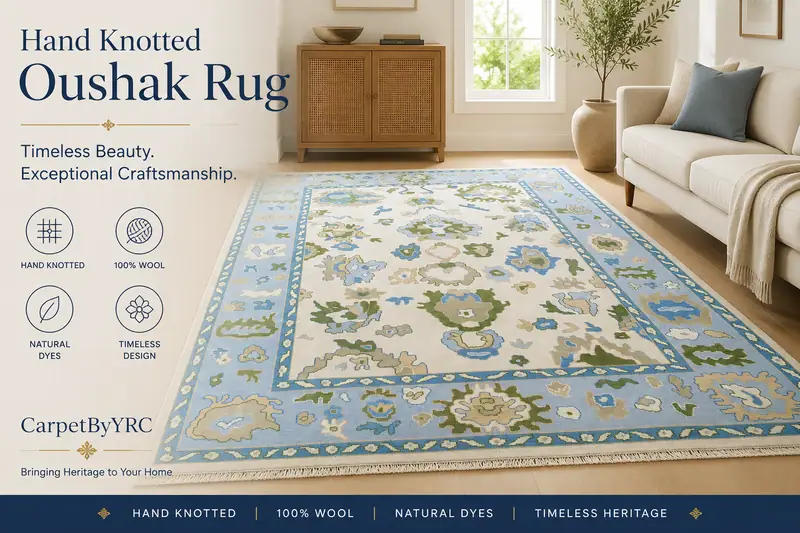
- Herati / Fish Design: Repetitive geometric field pattern with a flower head enclosed in a diamond with curved leaves — highly traditional, strongly associated with Bhadohi and Agra production
- Paisley (Boteh): Teardrop-shaped floral motif, originally from Persia (called boteh) — represents the sacred flame, a leaf, or the river meander; widely used in Indian carpet borders
- Geometric Tribal: Bold stepped diamonds, stars, and angular forms derived from nomadic carpet traditions of Central Asia — appears in simpler Bhadohi and Rajasthani pieces
Why Traditional Carpets Work in Modern Indian Homes
A common misconception is that traditional carpets only suit traditionally furnished rooms. In fact, a well-chosen traditional Indian carpet can be the most striking design element in a contemporary interior — precisely because it provides historical depth, artisan provenance, and design complexity that modern furniture and architecture alone cannot supply.
The contrast of a 200-year-old Herati motif design under a clean-lined modern sofa in a Mumbai apartment creates the kind of layered, culturally grounded interior that characterises sophisticated global taste. Interior designers call this "high-low mix" — and the traditional Bhadohi carpet is almost always the high element.
Frequently Asked Questions
What is the difference between hand knotted and hand tufted traditional carpets?
Hand knotted carpets are made by tying individual pile knots onto warp threads one by one — an ancient technique producing extremely dense, durable, and detailed carpets with lifespans of 50–100 years. Hand tufted carpets use a tufting gun to push pile through a canvas backing — faster, more accessible in price, and still entirely artisan-made. Both can carry identical traditional motifs; the difference is construction method, density, and price.
How much does a traditional Indian carpet cost?
Pricing spans a wide range depending on construction method (hand tufted vs hand knotted), material, size, and knot density. Browse our traditional carpet collection at rugstore.in/online-carpet-store/rugs-carpets/traditional-carpet/ for current pricing and availability.
Are traditional Indian carpets a good investment?
High-quality hand knotted Indian carpets — particularly fine Kashmiri silk and densely knotted Bhadohi wool pieces — have historically appreciated in value over decades. This is particularly true for carpets with certified provenance, natural dyes, and high KPSI. Hand tufted traditional carpets are not typically investment pieces but hold their use value for 15–25 years with proper care.
Can I use a traditional carpet in a modern apartment?
Absolutely — traditional Indian carpets are among the most effective design tools for adding warmth, character, and cultural depth to otherwise minimal modern apartments. The contrast between a traditional Herati or floral medallion design and clean contemporary furniture is a classic interior design technique that works particularly well in Indian urban apartments.
How do I identify a genuine hand knotted Indian carpet?
Flip the carpet over and examine the reverse. A genuine hand knotted carpet shows individual knots visible as small loops across the entire reverse surface — the pattern should be clearly readable from the back. The edges should be handwoven selvedges (bound in thread), not machine-cut and backed. Machine-made or power-loomed "traditional style" carpets have a smooth, uniform reverse with no visible knot structure.
-800x451.webp&w=1920&q=72)