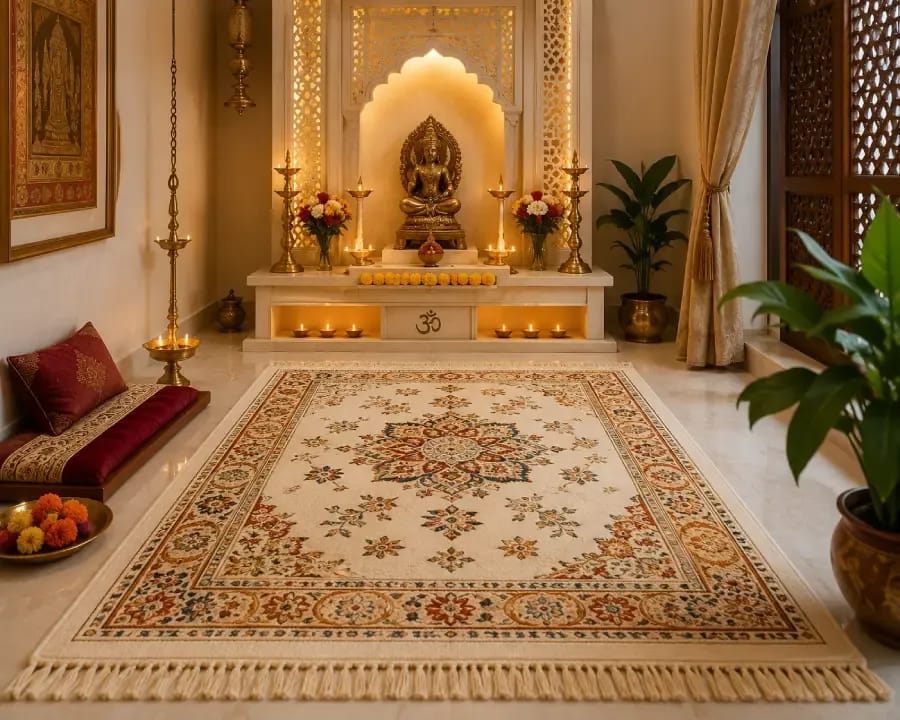
Puja Room Carpet India: How to Choose the Perfect Prayer Room Rug
By Akshata
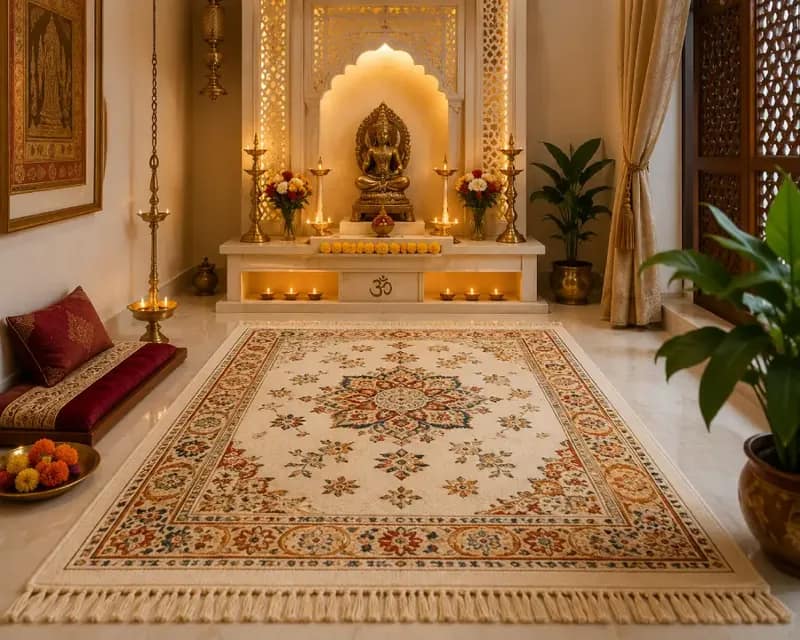
Rugs at Factory PriceShop All Rugs.
The puja room carpet is one of the most intentional purchases you will make for your home. Unlike a living room or bedroom rug — chosen primarily for aesthetics and comfort — a prayer room carpet carries spiritual weight. It defines the physical boundary of your sacred space, sets the mood for your daily devotion, and remains in contact with the floor of the most spiritually significant room in your house. Getting it right matters in a way that goes beyond interior design.
At Rug Store, we produce handmade rugs and carpets in Bhadohi, Uttar Pradesh — India's carpet-weaving capital — and we receive a steady stream of enquiries specifically about puja room carpets and pooja room rugs. Buyers want guidance on auspicious colours, appropriate materials, correct sizing for their home mandir, and practical care advice for a space where kumkum, turmeric, and flower petals are everyday realities. This guide covers all of it.
Whether you are setting up a dedicated prayer room in a 3BHK apartment in Delhi or placing a simple prayer mat in a corner of your Mumbai studio, the principles here will help you choose a puja room rug that honours both the spiritual and the practical dimensions of the space.
The floor covering in a prayer space does more than protect the floor. In Indian tradition, the act of removing footwear before entering the puja room is a ritual acknowledgement that the space is different from the rest of the home — it is sanctified ground. The carpet you place in that space becomes part of that sanctification. It should feel different underfoot, look intentionally chosen, and communicate reverence.
On the practical side, puja rooms generate specific types of mess that other rooms do not: kumkum powder, turmeric paste, flower petals, incense ash, agarbatti residue, and occasionally oil from diyas. A carpet that cannot handle these materials — either because the pile traps them, the fibres stain permanently, or the material cannot be cleaned without water damage — becomes a maintenance problem within weeks.
The ideal puja room carpet balances spiritual appropriateness (auspicious colours, traditional patterns) with practical durability (materials that clean easily, construction that does not trap ash or petals). Getting both right is the goal of this guide.
Material choice is the single most important decision you will make when selecting a puja room carpet. Different fibres behave very differently in a space where ritual substances are used daily.
Cotton is the most practical material for puja room carpets and our top recommendation for most Indian households. Cotton dhurries and flat-weave cotton carpets can be machine-washed at 30°C — a significant advantage when dealing with kumkum stains, turmeric residue, and petal debris that accumulates in a regularly used prayer space. Cotton fibre does not absorb stains as deeply as wool, and most stains that are treated promptly come out in a regular machine wash.
Cotton flat-weave carpets are also appropriately humble in texture — their firmness underfoot is considered by many devotees to reflect the discipline of prayer. A cotton carpet in saffron, white, or red for your puja space is both spiritually fitting and practically sound. Explore our cotton carpet collection at rugstore.in/online-carpet-store/rugs-carpets/cotton-carpet/ for flat-weave options in auspicious colours.
Wool has been used in Indian prayer spaces for centuries — it is the material of traditional dhurries, temple floor coverings, and the sacred mats used in puja ceremonies across the subcontinent. Wool's natural lanolin content gives it inherent resistance to dry powders: kumkum and turmeric sit on the surface of a wool pile rather than immediately penetrating, giving you response time to remove them before they set.
Wool prayer room carpets require dry cleaning rather than machine washing, which makes them less convenient than cotton for high-use daily puja spaces. However, for a more formal mandir room used primarily during morning puja and festivals, a hand-tufted wool carpet from Bhadohi's artisan workshops is a beautifully fitting choice — warm, natural, and grounded in tradition. Our hand-tufted rug range at rugstore.in/online-carpet-store/rugs-carpets/hand-tufted-rugs/ includes several designs in traditional motifs suitable for prayer spaces.
Jute has a long association with Indian ritual contexts — the rough, earthy quality of natural jute fibre connects to a sense of simplicity and groundedness that is appropriate for prayer. Jute rugs are among the most eco-friendly flooring options available, made from a fast-growing plant crop cultivated in Bengal and Bihar, and they are fully biodegradable at end of life.
The practical limitation of jute in a puja room is its sensitivity to moisture. Jute fibres degrade when repeatedly wet, and in a prayer space where water is used in rituals — abhishek, cleaning diyas, washing offerings — a jute carpet can become problematic if water is regularly spilled on it. Jute is best suited for drier prayer spaces where water contact is minimal. Explore jute options at rugstore.in/online-carpet-store/rugs-carpets/jute-rugs/.
Polypropylene, polyester, and nylon carpets are not recommended for puja rooms, and the reason goes beyond aesthetics. Synthetic fibres are produced through petrochemical processes and may have been treated with chemical finishes — flame retardants, anti-static treatments, and pile binders — that are at odds with the purity and sanctity associated with prayer spaces in Indian tradition. Many Hindu traditions specifically prefer natural materials (cotton, wool, silk, jute) in ritual contexts for precisely this reason.
Additionally, synthetic pile carpets generate static, trap incense ash and flower residue in ways that are difficult to clean, and lack the natural warmth and texture that make a prayer space feel alive and welcoming.
Colour is perhaps the most visible dimension of a puja room carpet's spiritual significance. Indian tradition assigns specific meanings, associations, and Vastu properties to each colour, and choosing an auspicious colour is considered an important aspect of setting up a proper prayer space.
Saffron — the deep orange-yellow colour of marigolds, turmeric, and the robes of sadhus — is the most universally auspicious colour in Hindu ritual contexts. It represents the fire element, spiritual purity, and the renunciation of material ego. A saffron or deep orange puja room carpet creates an immediately recognisable devotional atmosphere and aligns with the colour of the offerings and flowers most commonly used in puja.
Saffron also has the practical advantage of visually concealing turmeric residue and kumkum powder far better than any lighter colour. For daily-use prayer spaces, saffron is both the spiritually ideal and practically wisest colour choice.
Red is the colour of Shakti, of sacred vermilion (sindoor), of the auspicious thread tied at temples, and of the Navratri celebrations dedicated to the Divine Feminine. A red puja room carpet is considered highly auspicious, particularly in homes where the family tradition includes worship of Durga, Lakshmi, or Kali. According to Vastu Shastra, red in the south direction amplifies energy and vitality — if your prayer room faces south, red is especially fitting.
White is the colour of purity, of Goddess Saraswati (who is always depicted in white), of clarity of mind, and of the peace that prayer is meant to cultivate. A white or off-white cotton dhurrie in the prayer room creates a visually clean, serene atmosphere that supports focused devotion. White is also associated with Sattvic (pure) qualities in Indian philosophical tradition.
The practical challenge with white in a puja room is obvious — kumkum and turmeric stain white very visibly. Choose machine-washable cotton in off-white rather than pure white, treat stains immediately with cold water, and wash regularly. An ivory or cream cotton flat-weave is the most forgiving form of white for regular puja use.
Yellow — the colour of ripe turmeric, of the marigold garland, and of the auspicious paste applied at the beginning of ceremonies — is deeply associated with Lord Vishnu and with Basant Panchami, the festival of spring and learning. A yellow puja room rug brings warmth, positivity, and the energy of knowledge and prosperity. In Vastu Shastra, yellow is recommended in the north-east zone (the Ishanya corner), which is the ideal direction for the puja room in a home.
The patterns woven or printed on a puja room carpet carry visual and symbolic meaning. Traditional Indian carpet design has a rich vocabulary of motifs that are particularly appropriate for sacred spaces.
Geometric patterns — stars, octagons, lattice grids, and the stepped diamond forms derived from ancient Indian architectural motifs — have been used in Indian sacred art and temple decoration for millennia. A geometric carpet in saffron, red, or ivory for your prayer space connects the floor covering to this deep visual tradition. Geometric patterns also have the practical advantage of not creating a directional bias — unlike figurative motifs, they look equally correct from any angle of approach.
Rangoli patterns — the intricate floor designs created at the threshold of Indian homes during festivals and auspicious occasions — are among the most culturally resonant motifs for a puja room carpet. A carpet featuring rangoli-inspired lotus, kalash (sacred pot), or paisley motifs in saffron or red on a white or cream ground creates a beautiful connection between the daily ritual of rangoli-making and the permanent flooring of the sacred space. These are among the most meaningful puja room rug designs you can choose.
Floral patterns — particularly the lotus, the marigold, and the stylised flower forms of the traditional Indian carpet vocabulary — are auspicious across all Indian religious traditions. The lotus is the most significant: it is the seat of Brahma, the symbol of enlightenment in both Hindu and Buddhist traditions, and a form that appears repeatedly in temple architecture, manuscript illumination, and ritual objects. A lotus-patterned carpet in the puja room is both aesthetically beautiful and symbolically resonant.
Dark, chaotic, or aggressive patterns — including very busy multi-colour abstract designs, animal motifs, and geometric patterns that create a sense of visual restlessness — are considered inappropriate for sacred spaces in most Indian traditions. Similarly, very dark carpet colours (black, very dark navy) are generally avoided in puja rooms, as they are associated in Vastu Shastra with heavy, tamasic energy that is not conducive to the clarity and devotion that prayer requires.
Sizing a puja room carpet is different from sizing a living room or bedroom rug. The goal is not to fill the room or anchor furniture — it is to define the area of devotional activity: the space where the devotee sits, kneels, or stands during puja.
A 2x3 ft (60x90 cm) carpet is the size of a personal prayer mat — sufficient for one person to sit cross-legged or kneel comfortably during puja. This is the appropriate size for a small dedicated corner in a 2BHK or studio apartment where the mandir is a shelf unit against the wall and the prayer space is the area directly in front of it. It is also the right size for a travel or guest prayer mat.
A 3x5 ft (90x150 cm) carpet suits a family mandir where two or three people may pray together, or where the mandir unit itself occupies significant floor space. This size comfortably accommodates the activity zone in front of a floor-standing mandir in a bedroom or dedicated prayer corner. It is the most popular size for puja room carpets in Indian 2BHK and 3BHK apartments.
A 4x6 ft (120x180 cm) carpet is appropriate for a fully dedicated puja room — a separate room in a larger home where the mandir occupies one wall, there is space for multiple family members to sit and pray, and the room is used for longer devotional sessions, aarti, and festival celebrations. In a 3BHK or 4BHK home in Delhi, Hyderabad, or Mumbai where a room is specifically allocated to the mandir, a 4x6 ft carpet defines the prayer zone beautifully.
For very large dedicated prayer rooms in independent houses or villas, a 5x7 ft or 6x9 ft carpet may be appropriate. The guiding principle is that the carpet should cover the area where devotional activity takes place — it does not need to cover the entire room floor.
The sacred nature of a puja room does not exempt it from practical considerations — if anything, it makes them more important, because a carpet that is difficult to maintain will either look unkempt (diminishing the dignity of the space) or be cleaned infrequently (creating hygiene concerns in an area where the family gathers daily for ritual contact with the floor).
Flat-weave carpets — dhurries, kilims, and woven cotton constructions — are the most practical choice for puja rooms. Their low-profile surface means that incense ash, flower petals, and kumkum powder sit on the surface rather than embedding deep in the pile. They can be shaken out easily and cleaned thoroughly. High-pile shaggy carpets, however soft and luxurious they may feel, are genuinely unsuitable for prayer spaces — they trap ash and petals in the pile in a way that is very difficult to fully clean.
Most Indian puja rooms and prayer corners have marble, ceramic tile, or granite floors — extremely common in Indian apartment buildings. These polished surfaces make carpet movement a real risk, particularly during the movement of standing, sitting, and kneeling that accompanies puja. A carpet that shifts underfoot during prayer is both hazardous and disruptive to devotion. Always choose a puja room rug with latex-dotted anti-skid backing, or place a rubber rug pad underneath. Browse our anti-skid carpet collection at rugstore.in/online-carpet-store/rugs-carpets/anti-skid-carpet/ for flat-weave options with built-in anti-skid backing.
At Rug Store, we have curated a dedicated selection of carpets appropriate for prayer rooms — natural materials, auspicious colours, traditional motifs, flat-weave constructions, and anti-skid backing options. Browse our puja room rug collection at rugstore.in/online-carpet-store/rugs-carpets/puja-room-rugs/ to find designs sourced from Bhadohi's artisan tradition that honour both the spiritual and the practical requirements of your sacred space.
Regular care of your puja room carpet is itself an act of devotion — maintaining the cleanliness and dignity of the sacred space reflects the quality of attention you bring to your daily practice. The care routine for a prayer room carpet is shaped by the specific substances it encounters.
Shake the carpet outside at least once a week to remove accumulated incense ash, dry flower debris, and fine particulate matter. In Indian cities where ambient dust levels are high — Delhi, Jaipur, Agra — twice-weekly shaking prevents a visible layer of dust from settling into the weave. A gentle vacuum on the lowest suction setting (suction-only, no beater bar) can supplement shaking for flat-weave carpets.
Kumkum (vermilion powder) and haldi (turmeric paste) are the two most common and most challenging stains in a puja room context. The cardinal rule for both is cold water, not warm. Warm or hot water sets these pigments permanently into natural fibres. As soon as a kumkum or turmeric stain occurs, blot — never rub — with a clean white cloth to absorb as much dry powder as possible first, then apply cold water and blot again. Mild dish soap or a diluted white vinegar solution can help lift residual colour from cotton fibres.
Avoid any stain treatment with heat — no hot water, no hair dryer, no steam cleaner — on kumkum or turmeric stains. These are plant-based and animal-derived pigments that behave differently from food stains, and heat is the enemy. For stubborn stains on wool carpets, consult a professional dry cleaner who works with natural fibre rugs.
One of the most significant advantages of choosing a cotton flat-weave or dhurrie for your puja room is the ability to machine wash it. Cotton dhurries up to approximately 3x5 ft fit comfortably in a front-loading washing machine on a gentle 30°C cycle with a mild liquid detergent. Larger cotton puja room carpets can be hand-washed in a bathtub. After washing, dry flat in shade — not in direct sunlight, which can fade natural dyes — and ensure the carpet is completely dry before placing it back on the floor.
For more context on carpet investment across different categories and budgets, our carpet price guide at rugstore.in/blog/carpet-price-guide-india-2026/ covers material, size, and construction variables that affect the cost of any carpet, including prayer room options.
A cotton flat-weave dhurrie is the best all-round choice for most puja rooms — it is natural, machine-washable, available in auspicious colours, and its flat construction makes it easy to keep clean of incense ash and flower petals. Wool is the better choice for a more formal, premium prayer room where aesthetics are a priority and the carpet will be professionally cleaned. Avoid synthetic materials and high-pile constructions in sacred spaces.
Saffron (deep orange) is the single most auspicious colour for a Hindu puja room — it represents spiritual fire, purity, and devotion. Red is also highly auspicious and is associated with Shakti and prosperity. Yellow is recommended by Vastu Shastra for the north-east direction, which is the ideal placement for the puja room. White and off-white are appropriate for prayer spaces dedicated to Saraswati, for Sattvic devotional practices, or for households that prefer a serene, uncluttered aesthetic. Avoid black, very dark navy, and chaotic multi-colour patterns.
Yes — a cotton dhurrie is one of the most appropriate and practical choices for a puja room carpet. Cotton is a natural fibre with no chemical treatments that conflict with the purity standards of sacred spaces. Cotton dhurries in saffron, red, yellow, and white are traditional in Indian prayer contexts and have been used in home mandirs for generations. Their machine-washable property makes them particularly suitable for daily-use prayer spaces where kumkum and turmeric are regularly encountered.
The size depends on the type of mandir and how you use the space. For a small shelf-style mandir in a bedroom or living room corner, a 2x3 ft prayer mat is sufficient for one person. For a floor-standing family mandir used by two or three family members, a 3x5 ft carpet is ideal. For a fully dedicated puja room in a 3BHK or larger home, a 4x6 ft carpet appropriately covers the activity zone. The carpet should define the prayer area rather than fill the entire room.
Act immediately and use cold water only — never warm or hot water, which sets these pigments permanently. First blot up as much dry powder as possible with a clean cloth (do not rub). Then apply cold water and blot again with a fresh cloth. For cotton carpets, a small amount of mild dish soap or white vinegar diluted in cold water helps lift residual colour. Rinse with cold water and blot dry. Cotton dhurries can be fully machine-washed at 30°C after pre-treatment. Wool puja room carpets with stubborn haldi or kumkum stains should go to a professional dry cleaner experienced with natural fibre rugs.
Explore
Handcrafted rugs from verified Indian artisans and sellers — traditional weaves, modern designs, and everything in between. Delivered to your door.
Browse the Collection-800x451.webp&w=1920&q=72)