Hand Tufted Carpet Buying Guide India 2026 — Everything You Need to Know
By Akshata
Rugs at Factory PriceShop All Rugs.
If you are researching hand tufted carpet India options online, you have almost certainly encountered conflicting information — about quality, durability, price, and how hand-tufted compares to hand-knotted. This complete buying guide cuts through the noise and gives you everything you need to make a confident purchase in 2026.
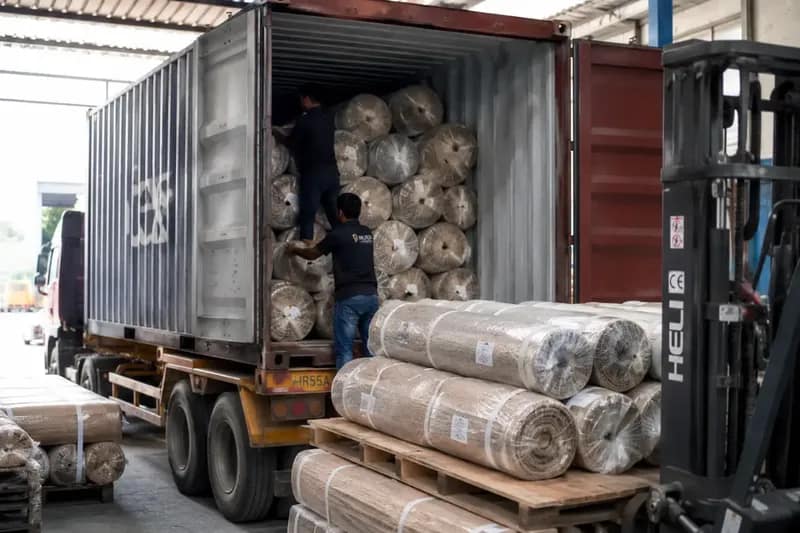
At Rug Store, we manufacture all our hand-tufted carpets directly in Bhadohi, Uttar Pradesh — India's carpet capital, a region with 500+ years of weaving tradition. We sell factory-direct, which means the prices you see reflect real manufacturing costs, not inflated retail margins.
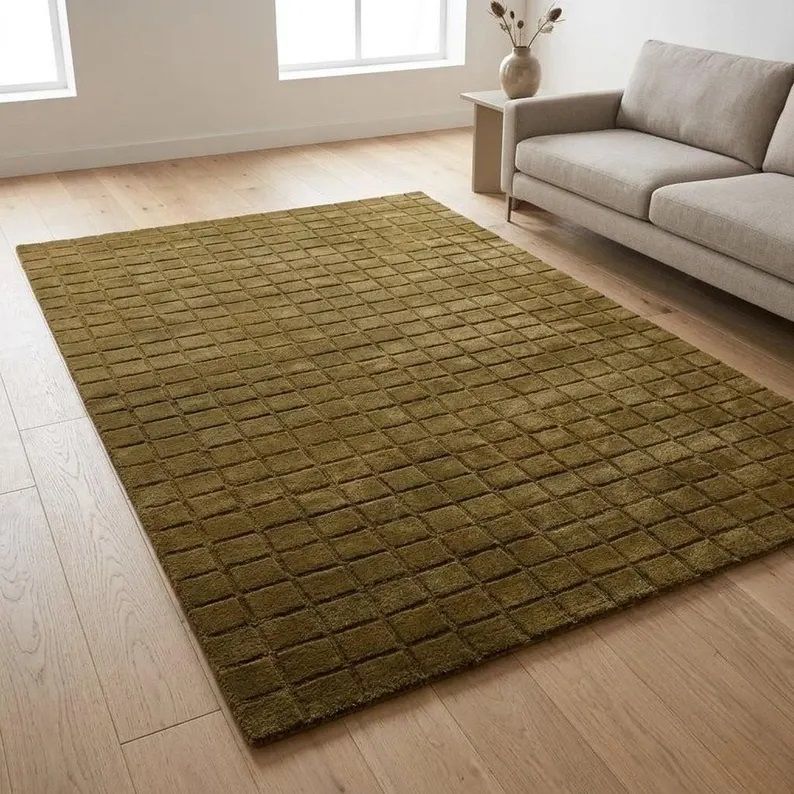
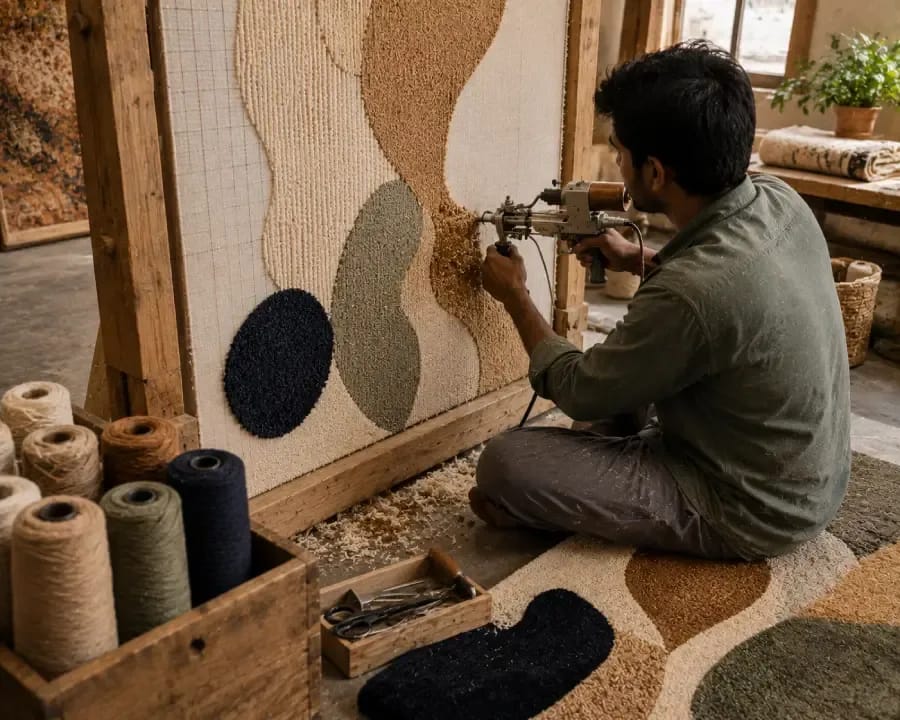
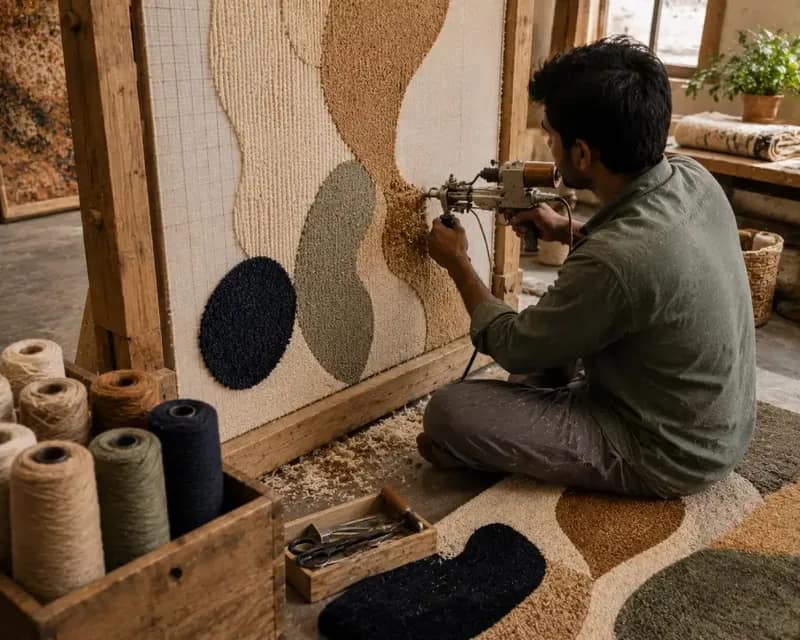
A hand-tufted carpet is made using a handheld tufting gun that punches yarn loops through a primary canvas backing. A skilled artisan guides the gun across a pattern stencilled on the canvas, creating the pile. The back is then sealed with latex and a secondary backing cloth is applied for stability.
This process is distinctly different from hand-knotting, where each individual knot is tied by hand around the warp threads. Hand-tufting is faster — a skilled artisan can complete a 6x9 ft rug in 3–5 days — which is why hand-tufted carpets are significantly more affordable than hand-knotted equivalents.
Despite the speed advantage, hand-tufted carpets are genuinely handmade. Every design decision, pile height adjustment, and colour placement is done by a human craftsperson. Our Bhadohi artisans bring decades of skill to this process.
Hand-knotted carpets are made by tying individual knots (Ghiordes or Senneh knot) around warp threads on a loom — a process that can take months or even years for large pieces. The knot density (measured in KPSI — knots per square inch) determines the fineness of detail and directly affects price. High-quality hand-knotted carpets from Kashmir or Bhadohi can have 200–400 KPSI.
Hand-tufted carpets use a tufting gun, eliminating the individual knotting step. The result is a pile that sits on top of the primary backing rather than being structurally woven into it. This is why the pile in hand-tufted carpets is held in place by latex — and it is also the reason hand-tufted carpets have a finite lifespan compared to well-maintained hand-knotted pieces.
A quality hand-knotted carpet with proper care can last 50–100 years or more. Some antique Persian and Kashmiri knotted carpets are centuries old. Hand-tufted carpets, when well-made and properly maintained, realistically last 15–25 years with everyday use in an Indian home.
The critical factor for hand-tufted durability is backing quality. Cheap rugs use brittle latex that cracks within 3–5 years, causing the pile to shed and separate. Our rugs use high-quality latex and cotton secondary backing — a combination that significantly extends usable life.
In the Indian market in 2026, the price range for each category varies considerably depending on size, material, and design complexity:
For the majority of Indian homebuyers seeking quality handmade carpets at a reasonable price, hand-tufted is the optimal choice. It delivers the look, feel, and artisan quality of a handmade rug at a fraction of the hand-knotted price.
New Zealand wool and Indian wool are the most common materials in hand-tufted carpets. Wool has excellent natural resilience — it bounces back after compression, making it ideal for high-traffic areas. It is also naturally flame-resistant and has a warm, rich texture that improves with age. Wool hand-tufted carpets typically cost more than synthetic options but offer the best long-term value.
Viscose (also called art silk or artificial silk) is derived from natural cellulose (wood pulp or bamboo). It mimics the sheen and softness of pure silk at a fraction of the cost. Viscose carpets look stunning in living rooms and formal spaces — the pile catches light beautifully. However, viscose is more sensitive to moisture than wool and should not be wet-cleaned. Dry cleaning is recommended.
The most popular hand-tufted carpet material in India in 2026 is a wool-viscose blend — typically 80% wool, 20% viscose, or 70/30. The wool provides durability and body; the viscose adds a silky sheen. This combination delivers premium look and feel at mid-range pricing.
Cotton is used primarily as backing material in hand-tufted carpets, but some flat-weave tufted rugs use cotton pile. Cotton pile rugs are lighter, easier to clean, and suitable for Indian summers. They lack the depth and warmth of wool but are practical for dining rooms and high-humidity spaces.
Pile height in hand-tufted carpets typically ranges from 5mm (low pile) to 25mm+ (shaggy). Here is how to choose based on Indian lifestyle requirements:
Indian interior design in 2026 blends global aesthetics with traditional sensibilities. The following design categories are performing strongly this year:
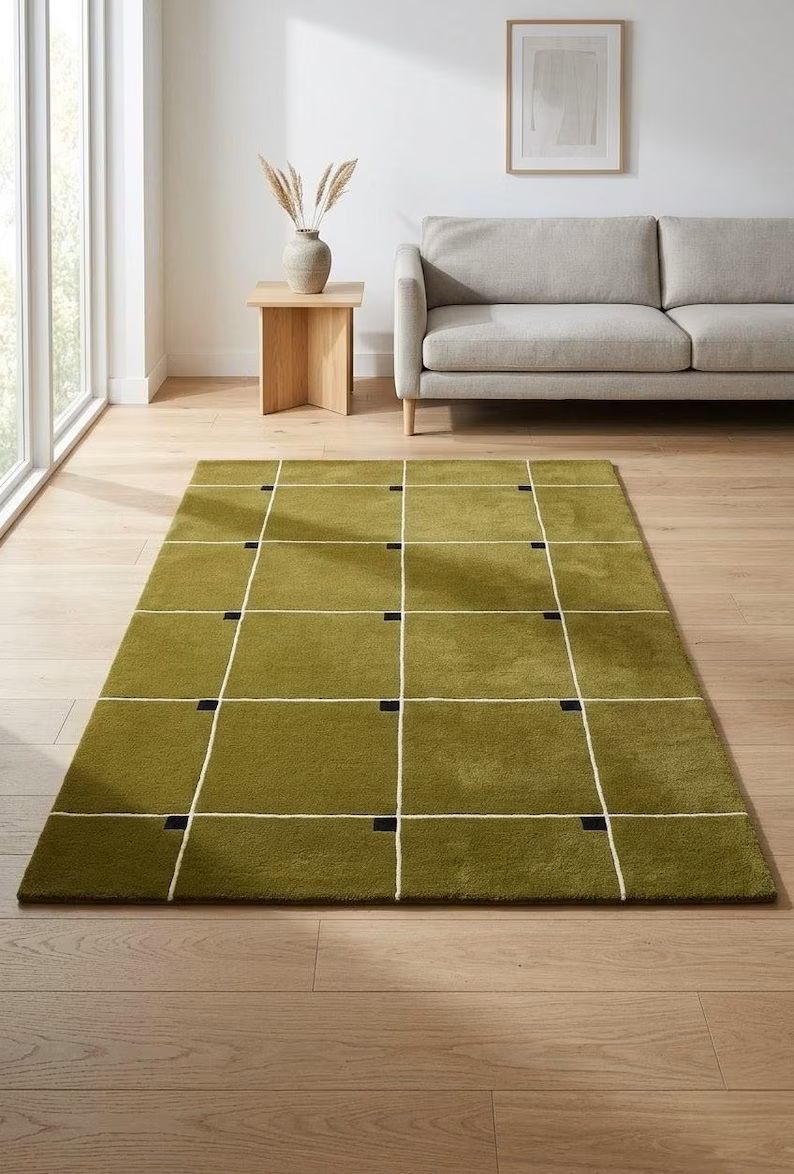
Clean lines, bold diamond or chevron patterns, and neutral palettes (ivory, charcoal, warm grey) pair well with both minimalist and contemporary Indian interiors. Browse our modern carpet collection for the latest geometric designs.
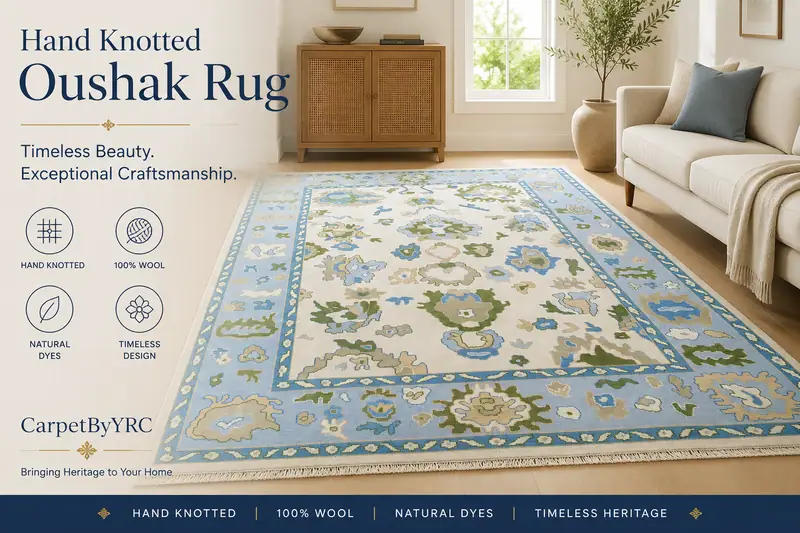
Rich reds, navy blues, and ivory grounds with medallion or all-over floral patterns suit traditional Indian interiors and are perennially popular in North Indian homes. Our traditional carpet collection features Bhadohi-crafted designs with authentic Persian and Mughal motifs.
Irregular shapes and abstract colour fields are trending heavily in 2026 — influenced by global design publications and Indian apartment renovation culture. An abstract hand-tufted carpet in muted earth tones makes a statement in any contemporary Indian interior.
When evaluating a hand-tufted carpet — online or in person — check these five quality indicators:
Bhadohi, Uttar Pradesh is the undisputed capital of carpet manufacturing in India — and in the world. The Bhadohi-Mirzapur-Varanasi belt accounts for the majority of India's carpet exports and centuries of weaving heritage. The region's artisan heritage dates back to the Mughal era, when Persian carpet weaving techniques were brought to India by royal patronage.
At Rug Store, every carpet leaves our Bhadohi workshop. We do not source from third-party manufacturers. This means we control quality at every stage — yarn selection, tufting, backing, and finishing. Our export-quality carpets are available to Indian buyers at domestic prices.
Prices for hand-tufted carpets in India vary based on pile material, pile height, size, and design complexity. See current pricing on our product pages.
Shop our hand-tufted rugs collection to see current prices. All prices include free standard shipping across India included in displayed prices.
Indian homes present specific care challenges: monsoon humidity, summer dust, children, and pets all test a carpet's durability. Follow these guidelines to maximise your carpet's life:
Hand-tufted carpets are made with a tufting gun that punches yarn through a canvas backing — an artisan-guided process that takes days. Hand-knotted carpets have each knot individually tied by hand around warp threads, a process that takes months or years. Hand-knotted carpets are significantly more durable and valuable; hand-tufted carpets offer artisan quality at a more accessible price point.
A well-made hand-tufted carpet with quality latex backing, proper regular vacuuming, and annual professional cleaning can last 15–25 years in normal Indian home use. Cheaper versions with thin latex can deteriorate within 5–7 years as the backing cracks and the pile separates.
Yes, if you choose the right pile height and material. Low-to-medium pile wool or wool-viscose blend hand-tufted carpets are perfectly suitable for Indian summers. High-pile shaggy hand-tufted carpets retain more heat and can feel warm in summer — they are better suited to air-conditioned bedrooms.
For most Indian buyers in 2026, a wool-viscose blend (70–80% wool, 20–30% viscose) offers the best combination of durability, sheen, and value. Pure wool is the most durable and long-lasting. Viscose-only is more affordable but requires more careful maintenance.
Light vacuuming and spot-cleaning can be done at home. For deep cleaning, professional washing is recommended for wool carpets. Viscose and silk-blend carpets should only be dry cleaned, as water can cause pile distortion and permanent watermarks.
At rugstore.in, we offer free standard shipping across India included in displayed prices. All our hand-tufted rugs are manufactured in Bhadohi, Uttar Pradesh, and are available in standard sizes from 2x3 ft to 10x14 ft, as well as custom sizes. Visit our hand-tufted rugs collection to browse the full range.
Yes. Our hand-tufted carpets use non-toxic yarn and water-based latex backing. We recommend pairing with a non-slip rug pad for safety, especially for children's rooms. Browse our kids rugs collection for designs specifically suited to children's spaces.
Explore
Handcrafted rugs from verified Indian artisans and sellers — traditional weaves, modern designs, and everything in between. Delivered to your door.
Browse the Collection-800x451.webp&w=1920&q=72)