Dhurrie Rug Buying Guide India: Cotton, Wool & Flat-Weave Explained
The dhurrie rug is one of India's oldest and most enduring textile traditions — a flat-woven floor covering that has furnished Indian homes for thousands of years. At Rug Store, we produce handmade dhurries in Bhadohi, Uttar Pradesh, and have compiled everything a modern Indian buyer needs to know: materials, patterns, room suitability, sizing, care, and how to distinguish a quality dhurrie from a cheap imitation.
What Is a Dhurrie Rug?
A dhurrie (also spelled durrie, dari, or duri) is a flat-woven textile made on a loom by interlocking warp and weft threads. No pile is raised — the finished surface is even, firm, and identical on both sides, making it reversible. The tradition spans Rajasthan, Punjab, Uttar Pradesh, Andhra Pradesh, and Gujarat, each with its own regional vocabulary of materials, colours, and patterns.
Flat-Weave vs Pile Rugs: The Fundamental Difference
A pile rug — whether hand-tufted, hand-knotted, or machine-made — has fibres standing upright from a backing. A dhurrie has none of these raised fibres: it is fully flat, firm, and slightly cool to the touch. The choice is partly practical (high-traffic area? want machine washability?) and partly aesthetic (softness and depth, or crispness and utility?). Explore our hand-tufted rug collection at rugstore.in/online-carpet-store/rugs-carpets/hand-tufted-rugs/ and our dhurrie collection at rugstore.in/online-carpet-store/rugs-carpets/dhurrie-rugs/.
The Reversible Advantage
When one side shows wear or a stain that resists cleaning, simply flip the dhurrie over. A quality cotton dhurrie, properly maintained, can serve as a reversible floor covering for eight to ten years or more.
Cotton vs Wool Dhurrie: Key Differences
The most consequential choice when buying a dhurrie in India is the material. Cotton and wool behave very differently in use, care, and aesthetics.
Cotton Dhurrie: Lightweight, Washable, and Ideal for Indian Summers
Cotton dhurries are lightweight (a 4x6 ft cotton dhurrie weighs approximately 1.5–2 kg), machine-washable at 30°C, and breathable — a genuine advantage during hot Indian summers. They are also the most affordable dhurrie option and the most widely produced in India. See our cotton carpet collection at rugstore.in/online-carpet-store/rugs-carpets/cotton-carpet/ for flat-weave cotton options.
Wool Dhurrie: Warmer, Heavier, and More Durable
Wool dhurries are heavier, warmer, and longer-lasting than cotton. They are associated with Rajasthani and North Indian weaving traditions. Not machine-washable — dry-cleaning required. Best for living rooms and dining spaces in cooler climates or air-conditioned interiors.
Popular Dhurrie Patterns
Indian dhurries are known for their geometric complexity. Traditional patterns include stripe patterns (horizontal or vertical, 2–4 colours), kilim-inspired geometric medallions (interlocking angular shapes), tribal motifs from Banjara and Rajasthani traditions, and modern abstract designs. See our traditional carpet collection at rugstore.in/online-carpet-store/rugs-carpets/traditional-carpet/.
Which Room Suits a Dhurrie?
Living Room
A large wool dhurrie (6x9 ft or 8x10 ft) anchors a seating arrangement with a lighter, more casual aesthetic than a pile rug. Layer over a jute or sisal base for texture contrast.
Bedroom
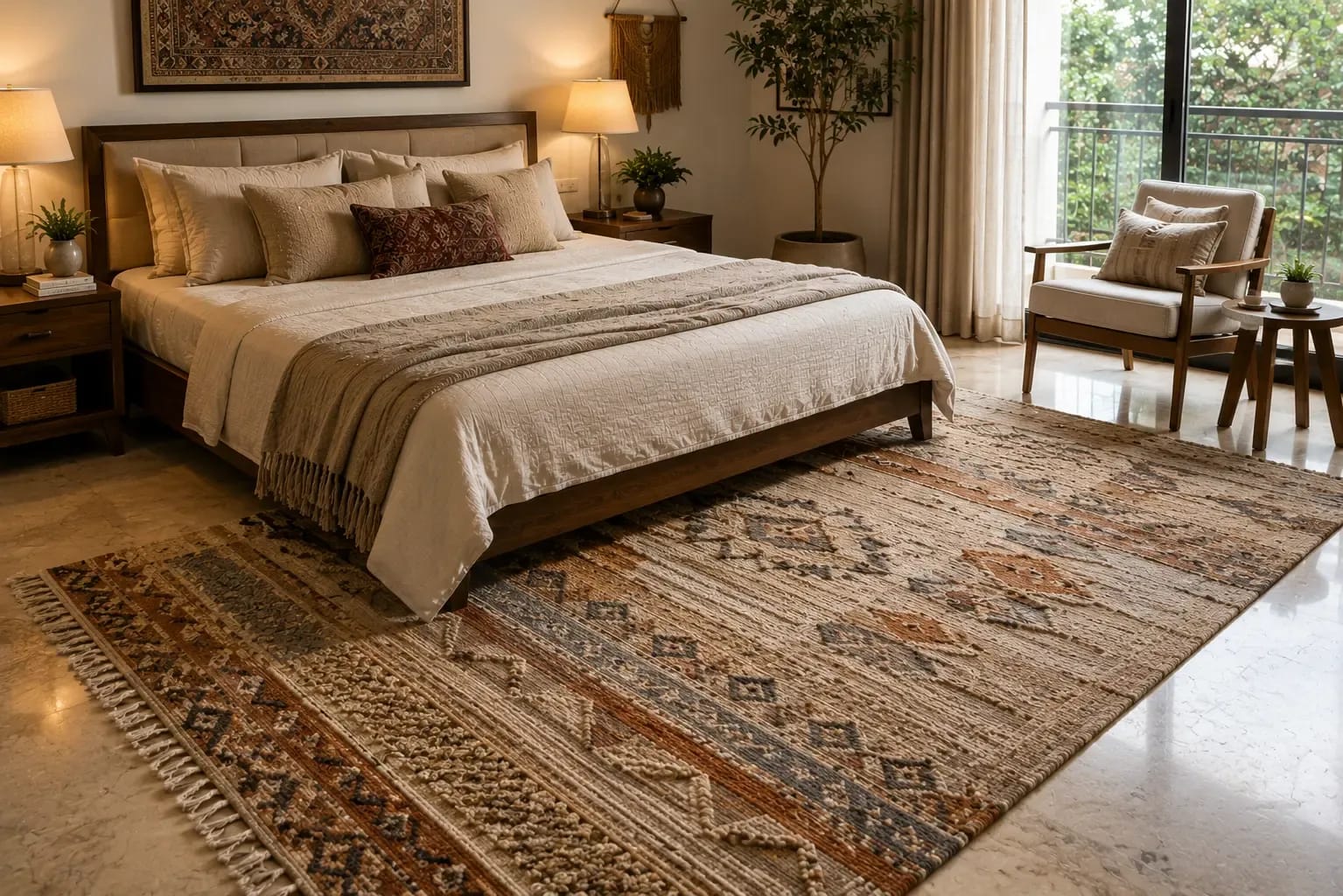
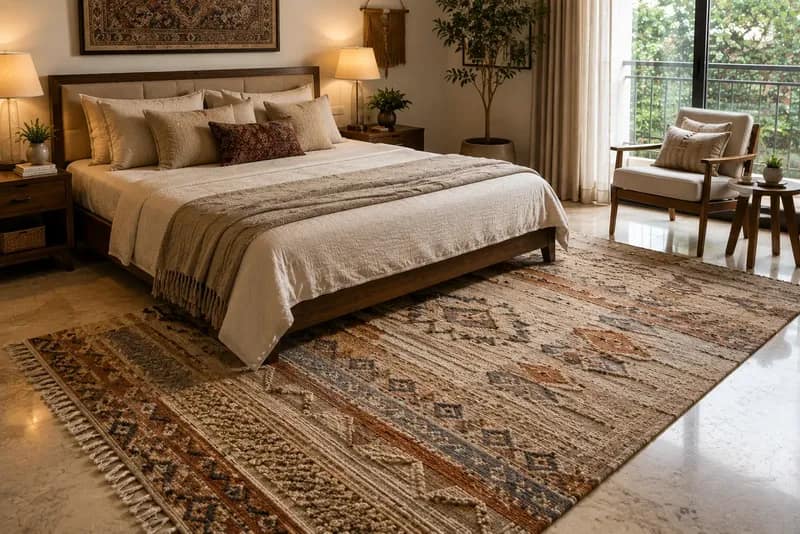
A cotton dhurrie runner alongside the bed (2x5 ft) or a full bedroom dhurrie (5x8 ft) is practical and easy to wash. Comfortable for bare feet, breathable in Indian summers.
Dining Room
Spills wipe up cleanly from a flat-weave surface. Choose a durable wool dhurrie in a darker pattern to hide food stains between washes.
Verandah and Outdoor Spaces
Cotton and jute dhurries suit Indian verandahs and semi-outdoor spaces — they dry quickly, handle monsoon humidity, and are easy to take outside for shaking and airing.
Sizing a Dhurrie for Your Room
- Living room: 6x9 ft for a standard 3BHK living room, 8x10 ft or 9x12 ft for larger spaces — front legs of all sofas should rest on the rug
- Bedroom: 5x8 ft under a queen bed (extending 45 cm on three sides); 2x5 ft runner on either side for a double bed
- Dining room: add 60 cm on all four sides beyond the table dimensions so chairs stay on the rug when pulled out
- Verandah: custom-cut sizes are available from our Bhadohi workshop for irregular or non-standard spaces
Care and Cleaning
- Cotton dhurries: machine-wash at 30°C on a gentle cycle; air-dry flat or on a line; never tumble dry
- Wool dhurries: dry-clean only; spot-treat with a damp cloth and mild wool-wash for fresh spills
- Vacuum weekly on a low-suction setting (no beater bar) for both cotton and wool
- Rotate 180° every three to six months to distribute wear evenly
- Treat spills immediately: blot, never rub; cold water only for turmeric stains
- Use a thin rubber pad underneath on marble or tile floors to prevent movement
Browse our dhurrie rug collection at rugstore.in/online-carpet-store/rugs-carpets/dhurrie-rugs/. For pricing context, see our carpet price guide at rugstore.in/blog/carpet-price-guide-india-2026/. free standard shipping across India included in displayed prices.
Frequently Asked Questions About Dhurrie Rugs
What is a dhurrie rug made of?
Dhurrie rugs are most commonly made from cotton or wool. Cotton is the most widely produced in India — washable, affordable, and suited to the Indian climate. Wool dhurries are heavier, warmer, and longer-lasting, associated with Rajasthani and North Indian weaving traditions. Jute and silk dhurries also exist. The flat-weave construction means the material is also the surface — there is no pile layer, so the quality of the fibre is fully expressed in the finished textile.
Are dhurrie rugs washable?
Cotton dhurries are machine-washable at 30°C on a gentle cycle. Sizes up to 4x6 ft fit in standard front-loading machines. Wool dhurries are not machine-washable and require dry cleaning. The flat construction makes spot-cleaning simpler than with pile rugs, as stains sit on the surface rather than embedding in pile fibres.
What is the difference between a dhurrie and a carpet?
A carpet has raised fibres that stand upward from a backing, creating a soft, thick, textured surface. A dhurrie is flat-woven with no raised pile — the surface is even, firm, and reversible. Carpets are softer and warmer. Dhurries are more washable, lighter, and more practical for warm climates and high-traffic areas. At Rug Store we produce both — see our hand-tufted rug collection for pile options.
Which dhurrie is best for a bedroom?
For a bedroom, a cotton dhurrie in ivory, warm beige, blush, or a subtle stripe works well as a runner or the primary floor covering. Cotton is comfortable for bare feet and machine-washable. If you want a warmer, more tactile surface and are willing to dry-clean, a wool dhurrie in a geometric pattern adds depth and warmth — particularly in North Indian homes in winter. A 5x8 ft dhurrie under the bed extending 45 cm on exposed sides is the standard approach.
How do I clean a wool dhurrie?
Wool dhurries cannot be machine-washed — water and agitation cause felting and shrinkage. Vacuum weekly on a low-suction setting (no beater bar). For spills, blot immediately with a clean cloth — never rub. For spot-cleaning, use a slightly damp cloth with mild wool-wash, working from the edge of the stain inward. For annual deep cleaning, use a professional dry cleaner experienced with natural fibre textiles. Well-maintained wool dhurries last fifteen to twenty years.
-800x451.webp&w=1920&q=72)