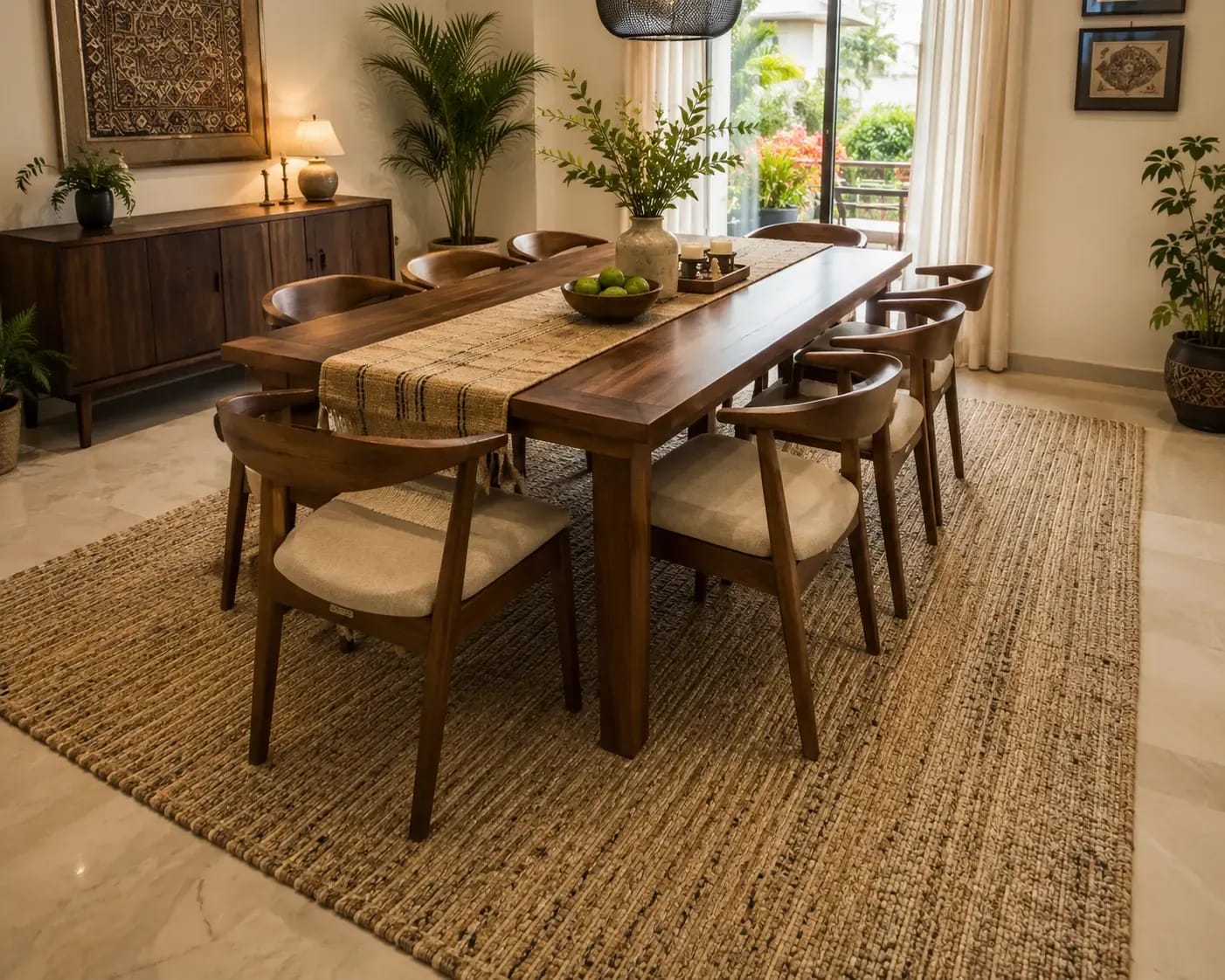
Dining Room Carpet India: What to Look For and Best Options
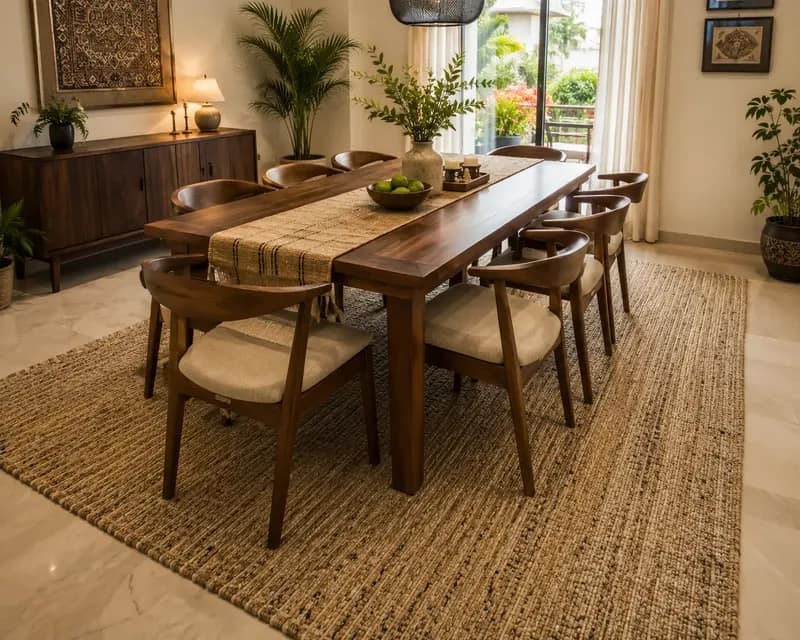
A dining room carpet in an Indian home faces a uniquely challenging set of demands. It must survive daily exposure to turmeric-laden dal, chai splashes, ghee, and the scraping of chair legs — all while looking elegant enough to serve as the backdrop to family meals, Diwali gatherings, Eid celebrations, and dinner parties. Getting the carpet choice right in a dining room requires prioritising practicality without abandoning design quality.
At Rug Store, we produce dining room carpets directly in Bhadohi, Uttar Pradesh — including the flat-weave cotton and jute options that are best suited to the specific demands of this room. This guide covers materials, sizing, Indian-specific stain challenges, and a practical ranking of what to choose (and what to avoid) under your dining table.
The Unique Challenges of a Dining Room Carpet
Before selecting a dining room carpet, understand what you are asking it to withstand. Indian dining environments are more demanding than Western equivalents for several reasons.
- Food spill complexity: Indian cooking uses turmeric, oil, curry paste, and red chilli — all of which are among the most staining substances any carpet will ever encounter
- Chair leg abrasion: Dining chairs are moved in and out repeatedly at every meal — the cumulative scraping effect is far greater than any other furniture movement in the home
- Foot traffic density: The dining area sees concentrated foot traffic multiple times daily at breakfast, lunch, and dinner
- Multipurpose use: In Indian homes, the dining table often doubles as a study space, work-from-home desk, and craft area — broadening the range of potential staining agents
- Floor seating contexts: Some Indian families combine dining table use with floor seating arrangements, particularly during festivals — requiring the carpet to function well at floor level too
Best Materials for Dining Room Carpets in India
Material selection is the single most important decision for a dining room carpet. Here is an honest ranking from most to least practical.
1. Flat-Weave Cotton: The Most Practical Choice
Flat-weave cotton carpets are the best all-round choice for Indian dining rooms. The flat construction has no pile to trap food debris, making it easy to sweep and spot-clean. Cotton can be machine-washed at 30°C, which is the most practical cleaning option for a carpet that faces daily food spill exposure. A flat-weave cotton dining rug can be removed, washed, and back in place within a few hours.
Available in a wide range of colours and simple geometric or striped patterns — though be realistic about colour selection (see the stain section below). Explore options at rugstore.in/online-carpet-store/rugs-carpets/dining-room-carpet/ for current pricing.
2. Jute Flat-Weave: Beautiful but Needs Sealing
Jute flat-weave rugs are visually stunning in dining rooms — the warm natural golden tone coordinates beautifully with wooden dining furniture and creates an organic, earthy aesthetic. However, raw jute absorbs liquids immediately and deeply, making spills very difficult to remove.
If you want jute in your dining room, apply a textile sealant before first use, and reapply every 12–18 months. This creates a moisture barrier that gives you a 30–60 second response window before a liquid spill penetrates the fibre. Treated jute in a dining room is manageable; untreated jute is a stain liability. See our jute range at rugstore.in/online-carpet-store/rugs-carpets/jute-rugs/.
3. Leather Patchwork: Wipe-Clean Luxury
Leather patchwork rugs from Bhadohi are one of the best-kept secrets for dining room use. The leather surface wipes clean with a damp cloth — turmeric, oil, and curry do not penetrate leather fibres the way they penetrate textile pile. Leather patchwork rugs are available in natural tan, black, and mixed-colour patchwork designs at rugstore.in/online-carpet-store/rugs-carpets/leather-rugs/.
The aesthetic is distinctly modern or industrial — not suitable for every dining room style. For Indian families who entertain regularly and want zero maintenance anxiety during meals, leather patchwork is a genuinely superior dining room choice.
4. Low-Pile Hand Tufted (Wool or Cotton): Durable Mid-Range
A low-pile (6–8 mm) hand tufted wool or cotton carpet from Bhadohi is a viable dining room choice if you accept that professional cleaning will be needed 1–2 times per year. The low pile prevents food debris from becoming embedded deeply, and the natural wool or cotton fibre responds reasonably well to spot cleaning if addressed quickly.
Choose mid-to-dark tones and geometric or abstract patterns that camouflage staining between professional cleans. Avoid light grey or off-white in the dining room regardless of how tempting they look in the catalogue.
5. High-Pile Shaggy: Avoid in the Dining Room
High-pile shaggy rugs are categorically unsuited to dining room use. Every food fragment dropped from the dining table disappears into the pile where it ferments, attracts insects, and creates persistent odour. Cleaning a shaggy rug contaminated with Indian spices is enormously difficult. If you have a shaggy rug in your dining area, replace it with a flat-weave. This is non-negotiable from a hygiene perspective.
Dining Room Rug Sizing Rules
The sizing rule for dining room carpets is straightforward and non-negotiable: the carpet must be large enough that all dining chairs remain on the carpet even when pulled out from the table.
A chair that slides off the carpet edge when pulled out creates a scraping point where the carpet edge abrades repeatedly against the hard floor and the chair leg catches on the pile transition. This damages both the carpet and the chair, and creates an unstable feeling that makes dining uncomfortable.
- Minimum 60 cm clearance on every side of the table beyond the outermost chair leg position (pulled out)
- 4-seater dining table (typically 90x160 cm): minimum carpet size 2.5x2.8 m (roughly 8x9 ft)
- 6-seater dining table (typically 90x180 cm): minimum carpet size 2.7x3.0 m (roughly 9x10 ft)
- 8-seater dining table (typically 100x240 cm): minimum carpet size 3.0x3.6 m (roughly 10x12 ft)
- Round 4-seater table (120 cm diameter): round carpet minimum 240 cm diameter; or square/rect 2.1x2.1 m
Indian Stain Removal Guide by Material
Stain management is the defining practical skill for dining room carpet ownership in Indian homes. Here are the most common Indian dining stains and how to address them for each material type.
Turmeric (Haldi)
Turmeric is one of the most challenging carpet stains because curcumin — the yellow pigment — is a natural dye that bonds with fibres. For flat-weave cotton: blot immediately, apply a paste of baking soda and cold water, let dry, brush off. Repeat. For wool: blot immediately, apply white wine vinegar diluted 1:1 with water, blot again. Professional clean if DIY fails. For jute: blot only; the stain will likely require professional dry cleaning. For leather: wipe immediately with a damp cloth — leather does not absorb turmeric if cleaned within 5 minutes.
Curry and Masala Gravies
Curry stains combine oil (which penetrates fibres) and pigment (which dyes them). Scrape solid matter first with a blunt knife or spoon. For oil content: apply cornstarch or baking powder to absorb oil, let sit 15 minutes, brush off. Then address the colour stain with cold water and mild dish soap — blot, do not rub. Hot water sets curry stains permanently; always use cold water as first response.
Oil and Ghee
Apply cornstarch or talcum powder immediately to absorb the oil. Leave 20–30 minutes, then brush or vacuum away. Follow with a few drops of dish soap worked into the stain with a soft brush, then blot with cold water. For wool carpets, avoid excessive water — blot dry immediately after cleaning. For flat-weave cotton, machine wash after pre-treating the stain with dish soap.
Indian Dining Room Contexts
Floor Seating and Festival Dining
Many Indian families supplement or replace dining table use with floor seating during festivals like Eid, Diwali, and family celebrations. If your dining area doubles as a floor seating space, prioritise a larger, thicker carpet — a 10–15 mm pile flat-weave cotton or low-pile hand tufted piece at rugstore.in/online-carpet-store/rugs-carpets/dining-room-carpet/ provides both comfort for floor seating and practicality for table dining.
Open-Plan Kitchen-Dining in Indian Flats
Modern Indian apartments increasingly feature open-plan kitchen-dining layouts where the carpet must define the dining zone without a physical partition. Use a carpet that is clearly distinct from the kitchen flooring in texture and tone to create a visual zone boundary. A flat-weave jute or cotton carpet in a warm ochre or terracotta tone against a neutral kitchen tile is a classic open-plan Indian home solution.
Frequently Asked Questions
Is carpet a good idea in an Indian dining room?
Yes — a well-chosen carpet makes the dining room warmer, quieter, and more comfortable, defines the dining zone in open-plan layouts, and protects the floor from chair scraping. The key is choosing the right material (flat-weave cotton, treated jute, or leather patchwork) and sizing it correctly so all chairs stay on the carpet. Avoid high-pile and light-coloured options in the dining room.
Which carpet is easiest to clean in an Indian dining room?
Flat-weave cotton is the easiest to clean — it can be machine-washed. Leather patchwork is the easiest to maintain on a day-to-day basis (wipe clean with damp cloth). Jute flat-weave with a sealant treatment is manageable. High-pile wool and shaggy carpets are the hardest to keep clean in a dining room — avoid them.
What is the right size carpet for a 6-seater dining table in India?
For a standard 6-seater Indian dining table (approximately 90x180 cm), you need a carpet of at least 270x300 cm (9x10 ft) to ensure all chairs remain on the carpet when pulled out. A slightly larger 300x360 cm (10x12 ft) piece is even better if your room dimensions allow. Too small is far worse than slightly too large in the dining room.
How do I remove turmeric stains from a dining room carpet?
Act immediately — turmeric bonds to fibres quickly. Blot the excess (never rub). Apply cold water with a small amount of mild dish soap or baking soda paste. For cotton: machine wash the carpet after pre-treating. For wool: professional cleaning is recommended for set turmeric stains. For jute: dry clean only. Apply a textile protector spray after any deep cleaning to restore moisture resistance.
Can I use a round carpet in an Indian dining room?
Yes — a round carpet works beautifully under a round or square dining table and creates a defined, contained zone. For a round carpet in a dining room, ensure the diameter is at least 60 cm larger than the table diameter to accommodate pulled-out chairs. A 240 cm diameter round carpet under a 120 cm round table is the minimum viable size for a 4-seater round dining arrangement.
-800x451.webp&w=1920&q=72)