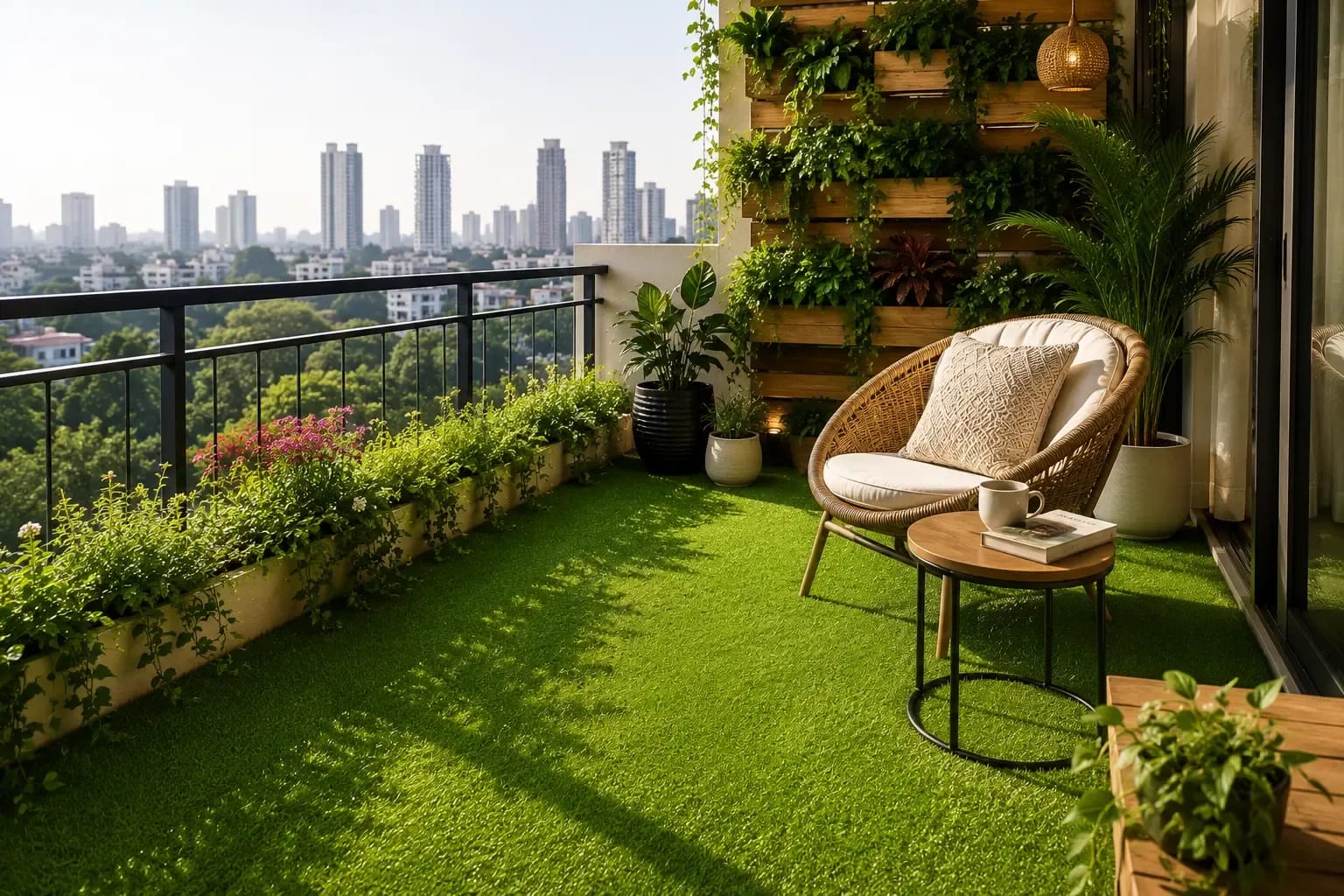
Artificial Grass Carpet for Balcony India: Options, Prices & Installation
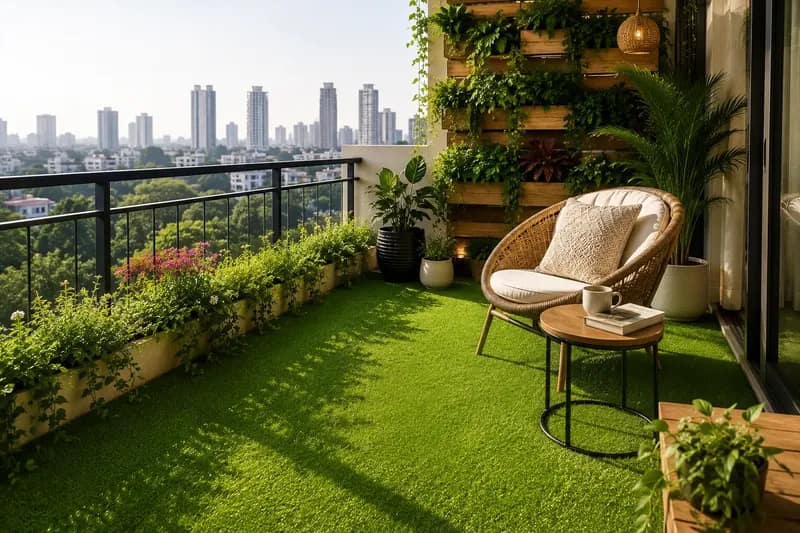
Artificial grass carpet India has become one of the fastest-growing categories in urban home decor, and it is easy to understand why. In cities like Mumbai, Bangalore, Delhi, and Hyderabad, apartment balconies are often the only outdoor space available to residents. A well-laid artificial grass mat transforms a bare concrete balcony into a green, liveable extension of the home — a pet zone, a morning yoga space, a chai-corner garden — without the watering, weeding, or maintenance of real grass.
At Rug Store, we stock a curated range of outdoor and artificial grass floor coverings alongside our traditional handmade rugs from Bhadohi, Uttar Pradesh. In this guide, we cover everything you need to choose the right artificial grass carpet for your Indian balcony or terrace — pile height, material, drainage, heat performance, price, and installation.
Why Artificial Grass is Ideal for Indian Balconies
Urban Indian apartments rarely have gardens. The balcony — typically 30 to 80 square feet in a standard 2BHK or 3BHK — is the only outdoor retreat. Artificial grass solves several problems at once: it provides a soft, green surface that is comfortable underfoot, it visually brings nature indoors, and it requires zero gardening skill or daily maintenance.
Approximately 70% of demand for artificial grass mats in India comes from apartment balcony applications. The remaining 30% splits between terrace gardens, kids play areas, pet zones, and outdoor dining setups in independent homes and villas. Indian monsoon and summer conditions make artificial grass particularly attractive — it handles heavy rainfall and intense UV exposure far better than most outdoor rugs.
Pile Height Guide: Choosing the Right Look and Feel
Pile height is the most important specification when selecting artificial grass. It determines both how the grass looks and how it feels underfoot.
15mm Pile: Dense and Clean
A 15mm pile is short, dense, and uniform — it looks closest to a well-maintained sports turf. The low pile stays neat, does not flatten under furniture, and is easy to brush clean. It is the most practical choice for balconies that double as dining or seating areas, where furniture legs would sink into taller pile.
25mm Pile: The Lawn Feel
At 25mm, artificial grass starts to feel genuinely lawn-like underfoot. It is soft enough to sit on directly and looks lush in photographs. This is the most popular pile height for Indian apartment balconies — it strikes the right balance between the clean 15mm look and the fuller 35mm garden effect. Most standard artificial grass mats sold in India at rugstore.in/shop/ fall in this range.
35mm Pile: Lush Garden Effect
A 35mm pile creates the most natural, garden-like appearance. It is noticeably soft, ideal for barefoot walking and kids play areas. The trade-off is that tall pile takes longer to dry after monsoon rains and can trap small debris like leaves and dust. If you have children who will play on the surface or a pet that needs a soft outdoor area, 35mm is the best choice.
Material: PE vs PP and Why It Matters in India
Most artificial grass in India is made from polyethylene (PE), polypropylene (PP), or a blend of both. Understanding the difference matters for Indian climate conditions.
- Polyethylene (PE): Softer, more natural-looking, UV-stabilised. PE fibres are gentler underfoot and retain less heat than PP. Most premium artificial grass products use PE or PE-dominant blends.
- Polypropylene (PP): Harder, more rigid, slightly less natural-looking, but extremely durable and abrasion-resistant. PP-backed grass retains more heat in peak Indian summer afternoons.
- PE/PP blend: The most common specification — combines PE softness in the blade with PP durability in the backing. Look for UV-stabilised blends for Indian sun exposure.
A critical consideration for Indian summers: artificial grass with black rubber backing retains significantly more heat than products with white PE backing. In cities like Delhi and Rajasthan where afternoon temperatures reach 45°C, the surface of a black-backed grass mat can become uncomfortably hot. The practical solution is to water the surface lightly in peak afternoon heat — evaporative cooling brings the surface temperature down quickly. Alternatively, choose products specifically labelled as "cool-touch" or "heat-deflective."
Drainage: Critical for Indian Monsoon
Drainage holes in the backing are non-negotiable for Indian balcony use. During monsoon season — particularly in Mumbai, Chennai, Kochi, and Goa — balconies can receive significant rainfall in a short period. Without drainage holes, water pools under the mat, creating a breeding ground for mosquitoes and potentially damaging the balcony floor surface below.
Look for artificial grass products with a minimum of 12 drainage holes per square foot. When laying the mat, ensure it is positioned so that water can flow toward the balcony drain. Avoid laying artificial grass over completely sealed surfaces without a slight gradient toward the drainage point.
Size Calculation for Your Balcony
Measure your balcony floor in feet or metres before ordering. Most Indian apartment balconies fall into these standard size ranges.
- 2BHK standard balcony: 6 x 8 ft to 7 x 9 ft. Order 6x8 ft or cut a 7x9 ft mat to fit.
- 3BHK large balcony: 8 x 10 ft to 10 x 12 ft. A standard 2x5 m roll cut to length works well.
- Terrace garden: Typically sold by the roll — 2m wide rolls in 5m, 10m, or 20m lengths.
- Kids play area: A dedicated 4x6 ft mat in 35mm pile on a terrace or dedicated room.
- Pet zone: 3x4 ft to 4x6 ft depending on pet size. Choose 25mm pile for easy cleaning.
Artificial grass is easily cut with sharp household scissors or a utility knife. Always add 3–4 inches to your measurements to allow for trimming and edge finishing.
Price Guide: What to Expect in India 2026
Artificial grass carpet prices in India vary significantly based on pile height, material quality, and backing specification. Here is a realistic 2026 price guide per square foot.
- Artificial grass carpet prices in India vary significantly based on pile height, material quality, and backing specification — spanning from economy single-colour PP products to premium UV-stabilised landscape-grade pieces. Pre-cut mats for standard balcony sizes are also available. Browse rugstore.in/shop/ for current pricing.
For a standard 2BHK balcony, a good quality 25mm PE/PP artificial grass carpet including material and simple self-installation is a cost-effective home improvement project. Contact us for a quote based on your specific balcony dimensions.
How to Install Artificial Grass on a Balcony
Self-installation is straightforward for most balcony applications. Follow this process for a clean, long-lasting result.
- Step 1 — Measure and order: Measure the balcony floor accurately. Add 3–4 inches buffer on each side.
- Step 2 — Clean the surface: Sweep and mop the balcony floor. Let it dry completely before laying.
- Step 3 — Lay the mat flat: Unroll the artificial grass and let it relax flat for 30–60 minutes. It will be easier to cut and position after settling.
- Step 4 — Cut to fit: Use sharp scissors or a utility knife with a straight edge to trim edges neatly.
- Step 5 — Secure edges: Use double-sided carpet tape or outdoor adhesive strips along the perimeter. For large terraces, use artificial grass joining tape for seams.
- Step 6 — Brush the pile: Use a stiff brush to lift the pile against the grain — this makes the grass look immediately more natural.
Maintenance: Keeping Your Artificial Grass Looking Great
Artificial grass in India requires minimal but regular maintenance to look its best through all seasons.
- Weekly: Rinse with a garden hose or bucket of water to remove dust and surface debris.
- Monthly: Brush the pile against the natural lean direction using a stiff-bristle brush. This prevents matting.
- Post-monsoon: Check under edges for any pooled water or dirt accumulation. Lift edges and clean if needed.
- Pet owners: Rinse immediately after pet use. Use a diluted pet-safe disinfectant monthly.
- Seasonal: In peak summer, a light water spray in the afternoon cools the surface and prevents heat damage.
Frequently Asked Questions
What is artificial grass carpet used for?
Artificial grass carpet is primarily used for apartment balconies, terrace gardens, kids play areas, pet zones, and outdoor dining areas in India. It creates a green, natural-looking surface that requires no watering or gardening maintenance. It is also increasingly used for indoor gym areas, office breakout spaces, and commercial displays.
Is artificial grass good for balconies in India?
Yes — artificial grass is one of the best balcony flooring choices for Indian apartments. It handles monsoon rain through drainage holes, tolerates UV exposure when UV-stabilised, and transforms bare concrete into a usable green space. It is particularly popular in high-rise apartments in Mumbai, Bangalore, Delhi, and Hyderabad where outdoor garden space is unavailable.
How much does artificial grass carpet cost in India?
Artificial grass carpet prices in India vary by pile height, material quality, and backing specification. Explore options at rugstore.in/shop/ and compare specifications before ordering.
Is artificial grass carpet waterproof?
Artificial grass itself does not absorb water — the blades are made from plastic polymers. However, whether the installation is effectively waterproof depends on the backing. Products with drainage holes allow water to pass through, preventing pooling. Always choose artificial grass with drainage holes for Indian monsoon conditions and ensure the balcony floor below has adequate slope toward the drain.
How to install artificial grass on a balcony?
Installation involves five steps: clean and dry the balcony floor, unroll and let the grass relax flat, cut to size with scissors or a utility knife, secure edges with double-sided carpet tape or outdoor adhesive, and brush the pile with a stiff brush to lift and naturalise it. Most balcony installations take 60–90 minutes and require no professional tools or skills.
-800x451.webp&w=1920&q=72)